

PROTECT YOUR VISION WITH EARLY DETECTION
What Is Myopia & Myopia Control
Helping Your Child See Clearly Today. Protecting Their Vision for Tomorrow.
Myopia (nearsightedness) is one of the most common vision conditions seen in children. It causes distant objects to appear blurry, while nearby objects are usually clear.
Myopia often develops during childhood and can progress as the eyes continue to grow.
More than 42% of North Americans are myopic, and that number is increasing at an alarming rate especially for children, estimated to go up to 58% by the 2050s
Higher levels of myopia are associated with a greater lifetime risk of certain eye conditions such as retinal holes and detachments, glaucoma, maculopathy and cataracts.
At Humber Bay Eye Care, we look beyond today’s prescription. We actively track how your child’s eyes are changing and use advanced treatments to slow down myopia progression, safeguarding their long-term vision and eye health.
SPECIALTY EYE CARE ETOBICOKE, MISSISSAUGA & TORONTO
What Is Myopia?
Myopia occurs when the eye focuses light in front of the retina instead of directly on the retina. This causes the eyes to elongate further and make one more myopic.
A child may have myopia even if they don’t complain about their vision. Children often adapt to blurry vision and may not realize that what they are seeing isn’t clear.
That is why regular children’s eye examinations are so important.
Common signs of myopia in children include:
✔ Squinting to see things in the distance
✔ Holding books or screens very close
✔ Difficulty seeing the board at school
✔ Frequent headaches or eye strain
Sometimes there are no obvious signs at all.
A comprehensive eye exam can identify myopia even when your child hasn’t noticed a problem.
Why Does Myopia Happen?
Myopia can develop for several reasons, including a combination of genetics and environmental factors.
Children may have a higher risk of developing myopia if:
✔ One or both parents are nearsighted – having a parent with myopia increases a child’s risk, and the risk is higher when both parents are myopic.
✔ They spend limited time outdoors
✔ They spend significant amounts of time doing close-up activities
Why Should We Manage Myopia?
As myopia becomes stronger, the eye becomes more elongated. Higher levels of myopia are associated with a greater lifetime risk of certain eye conditions such as:
✔ Retinal Detachment
✔ Myopic maculopathy
✔ Glaucoma
✔ Cataracts
The goal of myopia management is to slow the progression of myopia, rather than simply correcting the prescription each time it changes.
Why Should We Manage Myopia?
MYOPIA MANAGEMENT OPTIONS
Research supports several approaches that can slow myopia progression in children, including specialized spectacle lenses, specialized contact lenses and orthokeratology.
Specialized Myopia Management Spectacle Lenses
Certain spectacle lens designs are specifically designed to help slow myopia progression while providing clear central vision.
Myopia Management Contact Lenses
Certain specialized contact lens designs may help slow myopia progression in appropriate children.
Lifestyle & Environmental Changes
Spending more time outdoors and balancing prolonged near activities with regular breaks can also be part of a child’s overall myopia management plan.
Not every option is appropriate for every child. We will discuss the benefits, limitations, risks and expected outcomes of the available options before deciding on a treatment plan.
Visual Vulnerability
As myopia becomes more advanced, the eye becomes increasingly dependent on optical correction for clear vision. Higher prescriptions can also mean thicker, heavier lenses and greater reliance on glasses or contact lenses.
For some patients, long-term dependence on contact lenses may contribute to challenges such as contact lens intolerance, dryness or discomfort. This is one reason why slowing myopia progression early can be so important. Myopia management is not only about seeing clearly today. It is about protecting visual health and reducing the impact of higher myopia over time.
Your Child's Vision Is More Than A Prescription.
Myopia Management At Humber Bay Eye Care
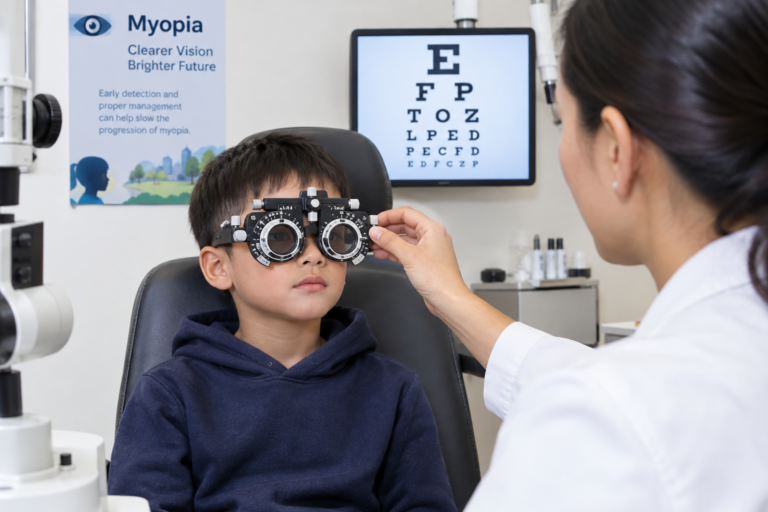
At Humber Bay Eye Care, our optometrists provide comprehensive children’s eye care and personalized myopia management based on your child’s individual needs.
Whether your child has just been diagnosed with myopia or their prescription has been increasing over time, we’re here to help you understand what comes next.
Frequently Asked Questions
At what age can children develop myopia?
Myopia commonly develops during childhood and can progress as the eye continues to grow. The earlier it develops, the more time there may be for progression.
Can myopia be cured?
Currently, there is no treatment that permanently reverses childhood myopia. Myopia management aims to slow progression and reduce the amount of myopia that develops over time.
Will regular glasses stop my child’s myopia from getting worse?
Regular glasses provide clear vision, but they are not specifically designed to slow myopia progression. Depending on your child’s situation, your optometrist may discuss myopia management options.
Does my child need myopia control if their prescription is only slightly changing?
Every child is different. We consider age, prescription, rate of progression, family history and other risk factors before recommending whether myopia management is appropriate.
How often should myopic children have their eyes checked?
Follow-up frequency depends on your child’s age, prescription and management plan. Your optometrist will recommend an appropriate schedule based on their individual needs.