

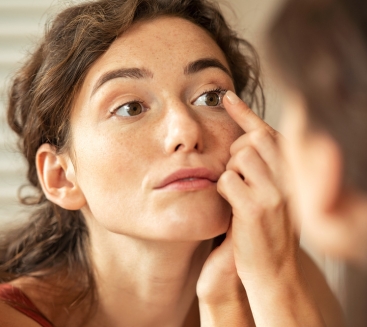
Why Are My Contact Lenses Suddenly Uncomfortable? The Real Reason Many People Stop Wearing Contacts
For many people, contact lenses provide clear vision and freedom from glasses. But if you’ve started noticing that your contacts feel dry, uncomfortable, or irritating by the end of the day, you’re not alone.
In fact, contact lens discomfort is the number one reason patients stop wearing contact lenses altogether. Studies estimate that between 12% and 27% of contact lens wearers eventually discontinue lens wear, with discomfort and dryness being the leading causes.
The good news? In many cases, the problem isn’t your contact lenses.
It’s your ocular surface.
At Humber Bay Eye Care in Etobicoke, we frequently help patients who thought they had “outgrown” contact lenses discover that treating an underlying dry eye condition allows them to comfortably wear contacts again.
Contact Lens Discomfort Isn’t Always a Contact Lens Problem
One of the biggest misconceptions is that if your contacts feel uncomfortable, you simply need a different brand.
While changing lens materials can sometimes help, repeatedly switching contact lenses without evaluating the health of your eyes often doesn’t solve the underlying issue. Eye care professionals are increasingly recognizing that many cases of contact lens dropout are actually caused by untreated dry eye disease and meibomian gland dysfunction (MGD).
Think of it this way.
A contact lens sits on top of your tear film. If your tears aren’t healthy, your lenses won’t be comfortable.
Signs Your Eyes May Be Causing the Problem
If you’ve experienced any of the following, your discomfort may be related to dry eye disease rather than your contact lenses:
- Your contacts become uncomfortable later in the day.
- Your vision fluctuates or becomes blurry while wearing contacts.
- You constantly reach for lubricating eye drops.
- Your eyes burn, sting, or feel gritty.
- You remove your lenses earlier than you’d like.
- Your eyes become red while wearing contacts.
- You find yourself wearing glasses more often because contacts no longer feel comfortable.
These symptoms often develop gradually, which is why many patients assume discomfort is simply part of wearing contacts.
It isn’t.
The Hidden Role of Meibomian Gland Dysfunction
Most dry eye disease isn’t caused by a lack of tears.
Instead, it’s caused by poor-quality tears.
Tiny oil glands along your eyelids, called the meibomian glands, produce the oily layer of your tear film. This oil slows evaporation and keeps your eyes comfortable.
When these glands become blocked or inflamed, tears evaporate too quickly. This condition, called meibomian gland dysfunction (MGD), accounts for the majority of dry eye cases seen in clinical practice.
Without a stable tear film, your contact lenses dry out faster, leading to irritation and reduced wearing time.
Why Screen Time Makes Contact Lenses Feel Worse
Many patients notice their contacts become uncomfortable during work, even if they feel fine in the morning.
One major reason is screen use.
When we work on computers, tablets, or phones, we blink less frequently and often blink incompletely. This allows tears to evaporate faster and prevents the meibomian glands from releasing enough oil to protect the eye.
If you spend most of your day on digital devices, your contact lenses may simply be exposing an existing dry eye problem.
Other Reasons Contact Lens Wear Becomes Uncomfortable
Dry eye isn’t the only factor that affects contact lens comfort.
Other contributing factors include:
- Seasonal allergies
- Blepharitis or eyelid inflammation
- Demodex mites
- Hormonal changes
- Certain medications
- Poor lens hygiene
- Wearing lenses longer than recommended
- Sleeping in contact lenses
- Environmental factors such as air conditioning or smoke
A comprehensive contact lens evaluation helps determine exactly what’s contributing to your symptoms.
Can You Wear Contact Lenses If You Have Dry Eye?
In many cases, yes.
The key is treating the underlying cause first.
Rather than immediately giving up on contact lenses, your optometrist may recommend:
- Treating meibomian gland dysfunction
- Managing eyelid inflammation
- Preservative-free lubricating eye drops
- Heat mask therapy
- Lid hygiene
- In-office dry eye treatments when appropriate
- A different contact lens replacement schedule or material once the ocular surface is healthier
Patients are often surprised by how much more comfortable their lenses become after their dry eye is properly managed.
Why an Eye Exam Is Essential
Simply changing contact lens brands without evaluating the health of the eye often leads to frustration.
During a comprehensive contact lens assessment, your optometrist can evaluate:
- Tear film quality
- Meibomian gland function
- Corneal health
- Eyelid inflammation
- Contact lens fit
- Wearing habits
- Lifestyle factors that may contribute to discomfort
By identifying the root cause, treatment can be tailored to improve comfort instead of relying on trial and error.
Don’t Give Up on Contact Lenses Just Yet
If your contact lenses no longer feel as comfortable as they once did, it doesn’t necessarily mean you’re no longer a good candidate for contact lenses.
For many patients, discomfort is simply the first sign of an underlying dry eye condition that can be treated.
At Humber Bay Eye Care, we take a comprehensive approach to contact lens discomfort by evaluating both your lenses and the health of your ocular surface. Our goal is to help you achieve comfortable, healthy vision while reducing the risk of permanently giving up contact lenses.
If your contacts feel dry, irritated, or uncomfortable, book a comprehensive eye examination or dry eye evaluation today. We can help identify the cause and recommend personalized treatment options so you can get back to wearing your contact lenses comfortably.
Humber Bay Eye Care
2129 Lake Shore Blvd. W.
Etobicoke, ON M8V 0B3
Whether your symptoms are mild or severe, we’ll work with you to develop a personalized treatment plan that targets the root cause, not just the symptoms.
Visit Us: 2129 Lakeshore Blvd West, Etobicoke, ON, M8V 0B3
Hours: Mon–Wed 10:00am–7:00pm | Thurs-Friday 9:00am–6:00pm
Contact: 416-259-3553 | info@humberbayeyecare.com